Thursday, March 15, 2007

Students in action

Mandarin Corner brought a battle against the sexes as we split the boys and girls up to play some games in Chinese. In the photos below our students are playing a game where they choose an envelope full of words and must make a correct sentence from them and then say what it means.

People are competitive by nature and it was no difference here as the boys were in minus points and the girls were up in the lead...... but it was not long before the guys fought back and won the game - still with disputes over our points system!!


Monday, March 12, 2007

Chinese Stone Lions


I have been asked by two students why there are often two stone lions in front of the gates of some buildings which really caught me out of guard. I have been seeing stone lions so often that I never questioned why people put them in front of their doors.

So I went on the internet to look for the answer, as Ben said, everything is “googlable”. The following is what I found:

There was no lions in China originally. The earliest stone lions were sculpted at the beginning of the Eastern Han Dynasty (25 - 220 AD) with the introduction of Buddhism into ancient China. In the Buddhist faith, the lion is considered a divine animal of nobleness and dignity, which can protect the Truth and keep off evils.

Lions are symbols of strength, power and dignity. In china, its imagines especially represented power and prestige. A pair of stone lions, a male and a female, can often be seen in front of the gates of traditional buildings. The male lion is on the left with his right paw resting on a ball, and the female on the right with her left paw fondling a cub. The ball played by the male lion symbolized the unity of the empire, and the cub with the female thriving offspring.

The most common material used to carve the lions is stone. But metal lions are also very commonly seen in front of the buildings. ( The photos shown here are taken by me last winter in the Forbidden City of Beijing. Can you tell me which one is male? Which one is female?)

Maybe you have other questions about the stone lions, write to me and I will try my best to answer your questions.

Wednesday, February 28, 2007

Chinese language partner for as little as 8 RMB!!

8 RMB for a Chinese language partner?!?! Is this possible you ask! I am sure the picture has given it away and you have guessed I am talking about the friendly taxi drivers that many of us spend time with everyday (and no comments that they are not all nice!!). Simply chat with your cabbie and practice your Chinese - easy!!

Most of the drivers in Guangzhou speak Mandarin as their first language, admittedly they may have a Funan (hmmmm, Hunan) accent or they may be local drivers with a Cantonese accent, but either way it is a great opportunity to speak Chinese. People always tell me they do not want to make a fool out of themselves with their friends and colleagues as their language skills are not good. This is even more of a reason to use the taxi driver as your language partner because the chances of seeing them again are limited so who cares if you make a few mistakes!!

Introduce yourself, ask him some questions, say anything you like. It will help you to remember what you have learned, can build your confidence and you can even learn some new words and phrases as your skills develop. At the end of your journey you can even grab the fapiao and claim the 'language training' on your expenses!

Trip to the flower market

As Ben mentioned in his blog on February 12, 9 adults and 6 children including Koco and I set off on February 15 to the Xihulu flower market - the oldest spring festival flower market in Guangzhou. We took a lot of pictures. Students bought “wu3dai4tong2tang2guo3” (five generation in a family) which is a very traditional spring festival plant in Guangzhou and some other flowers. Their picture also made the way onto the front page of the Guangzhou Daily newspaper. Here are some other pictures:


Tuesday, February 13, 2007

Mandarin Corner - 11th March


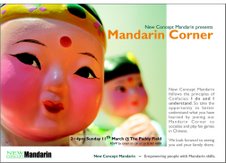
Next month we will hold our third Mandarin Corner on Sunday 11th March. It will be a chance for our students, their friends and anyone else to come along and practice their Mandarin. Our trainers will organise fun games in Chinese so feel free to pop in and take a look.

Three Little Pigs - Chinese style

Following on from Tina's earlier post about Pigs I thought I would share this interesting flash cartoon movie. Its the story of the Three Little Pigs; the catch.... its all in Chinese! It includes the script in Chinese characters, pinyin and English. Its hilarious... Enjoy!

http://www.chineseblast.com/node/118

Pigs; good or bad? That is the question!

Last time, I talked about “Dogs in Chinese eyes”. As the pig year is coming, I now will talk about the pig.

A pig ironically has a dual image - both positive and negative in Chinese culture. On one hand, pig represents people who are sloppy, lazy, greedy and dirty. On the other hand, pig also represents good luck and wealth. This year is strongly believed to be the “year of the golden pig” which returns every 60 years. People believe children born this year will be blessed with good luck and financial wealth. As wedding halls were crowded in 2006, maternity hospitals are expected to be packed in 2007.

Despite people’s strong belief about the “year of the golden pig”, all of the limited idioms about pig in Chinese are bad meanings.

Here is the most famous saying about pig in china:
ren2pa4chu1ming2zhu1pa4zhuang4” which literally means pigs are afraid to be fat and people are afraid to be famous. If pig is fat enough, it will be killed. If a person gets famous, he/she will get involved with a lot of troubles. This saying is deeply rooted in the Chinese philosophy of “zhong1yong1” (the “golden mean” of the Confucian school) which is the way of wisdom and safety between extremes; sufficiency without excess; moderation.
What do pigs represent in your country? Write to us and tell us some stories.
 
Our Center’s Blogs - Dongguan||Guangzhou||HongKong||Manila||Nanjing||Shanghai||Shenzhen||Singapore||Suzhou
Our Other Blogs - Corporate||Teacher's
Our Homepage - NCM’s Homepage